-
Call Now
1800-102-2727



VBT- Valence Bond theory, Postulates, Types of covalent bonds, Sigma and pi-bonds, Advantages, VBT and coordination compounds, Disadvantages, Practice Problems and FAQs
Molecules have different shapes. Do you know why and can you guess the shape of a given molecule?
You can do it if you know about VBT and its advancement “hybridization”.
Elemental atoms except the noble gasses have incomplete octet shells and are reactive to have an octet configuration. The two most predominant ways of doing this are ionic bonding and covalent bonding with other atoms. Lewis was the first to propose the formation of bonding between half-filled localized atomic orbitals between two atoms. Heitler and London extended this type of bonding using wave mechanics which was further developed by Slater and Pauling as the Valency bond theory.
Table of Contents
- Valence Bond Theory and its Postulates
- Type of Covalent bonds
- Advantages of Valence bod theory
- VBT and coordination compounds
- Hybridisation in coordination compounds
- Some important compounds and their hybridisation
- Disadvantages of Valence Bond
- Practice Problems
- Frequently asked Questions
Valence Bond Theory
According to Bohr’s model, atoms have electrons distributed in quantized energy orbitals around the nucleus at specific distances. Valence bond theory postulates that atoms with half-filled orbitals can interact and overlap with one another to have filled orbitals. The new overlapped orbital is called a covalent bond, binding the two atoms with the electrons localized between them.
Pauling proposed the valence bond theory and its postulates are:
- Atoms with half-filled or unpaired electrons containing orbitals can overlap with another such orbital to form a covalent bond.
- The unpaired electrons of the overlapping orbitals must be of opposite spin
- The overlapping orbitals shall be of similar energies.
- The overlapping orbitals can be of the same or different atoms.
- The more the number of unpaired orbitals will be the number of covalent bonds.
- Larger the overlapping stranger the more covalent bond
- Electrons are localized between the atoms
- The suborbital has a particular orientation in space, each covalent bond will be direction oriented along with the bonding orbitals.
- Overall direction of all covalent bonds decides the shape of the molecule formed
Types of overlapping and covalent bonds
Orbitals can overlap either horizontally one over the other or laterally with bending. Accordingly two types of covalent bonds, sigma covalent bond and pi covalent bond are named respectively.
Sigma bonds: Sigma bond is formed when the atomic orbitals overlap along their internuclear axis.

Three different type of sigma bonds are formed by the overlap of suborbitals of:
(1) s-s
(2) s-p and
Pi bond: These are formed when the suborbital overlap along the sides of the sigma bonds.This is called lateral overlap and will be at perpendicular angle to the already exiting sigma bond. The overlapping orbitals can form only one sigma bond but multiple pi-bonds between themselves. Unlike sigma bonds pi-bonds do ot decide the shape of the molecule.
Sigma bond vs pi-bond
|
Property |
Sigma bond |
pi-bond |
|
Formation |
Along the internuclear axis |
Perpendicular to the internuclear axis |
|
Extend of overlapping |
Maximum |
Minimum |
|
Bond strength |
Strong |
Weak |
|
Rotation around |
Possible |
Not Possible |
|
Shape |
Responsible |
Not responsible |
|
Sub orbital involved |
S-s. s-p, p-p |
p-p |
Advantages of VBT
- Could explain the bonding between electron deficient atoms as per octet configuration.
- Explain the directional orientation and hence the shape of the molecule.
- Applicable to explain the bonding in coordination compounds
VBT applied to Coordination compounds
Werner was the first to describe coordination compounds' bonding properties. However, his idea was unable to solve basic questions such as
(i) Why do only a few elements have the unique ability to produce coordination compounds?
(ii) What gives coordination compounds their directional bonds?
(iii) What are the magnetic and optical characteristics of coordination compounds?
Valence Bond Theory (VBT), Crystal Field Theory (CFT), Ligand Field Theory (LFT), and Molecular Orbital Theory are some of the theories that have been proposed to explain the nature of bonding in coordination compounds (MOT). We will concentrate on the fundamentals of the application of VBT to coordination molecules.
In 1931, The valence bond theory, VBT, was extended to coordination compounds by Linus Pauling.
The main postulates of VBT are
- The formation of a complex involves a reaction between a Lewis base (ligand) and a Lewis acid (metal or metal ion) with the formation of a coordinate covalent (or dative) bond.
- To form a bond, VBT utilizes the concept of hybridisation, in which (n-1)d, ns, np or ns, np, nd orbitals of metal atoms are or ion hybridized to yield a set of equivalent orbitals of definite geometry.
Sometimes, the unpaired (n-1)d electrons pair up as fully as possible before
hybridisation, thus making some (n-1)d orbitals vacant for hybridisation.
- These hybrid orbitals are allowed to overlap with ligand orbitals that can donate electron pairs for bonding. Consequently, these bonds are of equal strength and are directional in nature.
- Which d-orbitals are used depends on the number of unpaired electrons as determined by the magnetic moment of the compounds.
- The hybridisation and shape of the complexes can be predicted using known properties such as the magnetic moment.
Hybridisation in coordination compounds
|
C.N. of metal |
4 |
4 |
5 |
6 |
6 |
|
Type of hybridisation |
sp3 |
dsp2 |
sp3d |
sp3d2 |
d2sp3 |
|
Shape of complex |
Tetrahedral |
Square Planar |
Trigonal Bipyramidal |
Octahedral |
Octahedral |
|
Type of d-orbital |
- |
dx2-y2 |
dz2 |
dx2-y2, dz2 |
dx2-y2, dz2 |
Some important compounds and their hybridisation
Note: Inner orbital complex: In complex formation, the inner d-orbitals are used in the hybridisation.
Outer orbital complex: In complex formation, the outer d-orbitals are used in hybridisation.
The cobalt ion is in the +3 oxidation state and has the electronic configuration 3d6 in the diamagnetic octahedral complex .
Information:
The diagram depicts the hybridization scheme.

[Co(F)6]3-
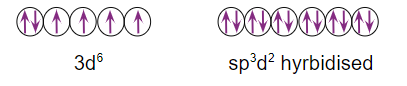
In hybridisation, the paramagnetic octahedral complex employs outer orbital (4d) (sp3d2 ). As a result, it is known as the outer orbital, high spin, or spin-free complex.
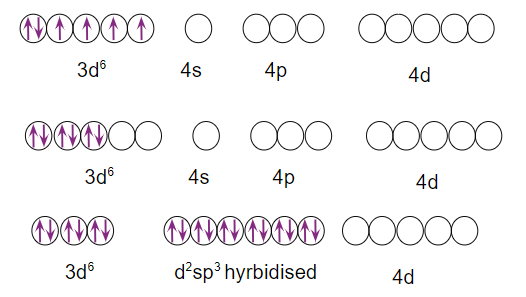
The cobalt ion is in the +3 oxidation state and has the electronic configuration 3d6 in the diamagnetic octahedral complex.
Information:
n=0
The diagram depicts the hybridization scheme.

[Co(NH3)6]3+ (no unpaired electron)


In hybridisation, the diamagnetic octahedral complex employs inner orbital (3d) (d2sp3 ). As a result, it is known as the inner orbital, low spin, or spin paired complex.
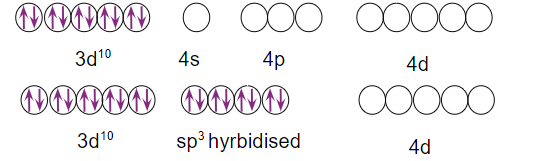
- [Ni(CN)4]2-
The nickel ion is in the +2 oxidation state and has the electronic configuration 3d8 in the diamagnetic square planar complex [Ni(CN)4]2-.
Information:
n=0
The diagram depicts the hybridization scheme.

(no unpaired electron)


In hybridisation, the diamagnetic square planar complex employs inner orbital (3d) (dsp2). As a result, it is known as the inner orbital, low spin, or spin paired complex.
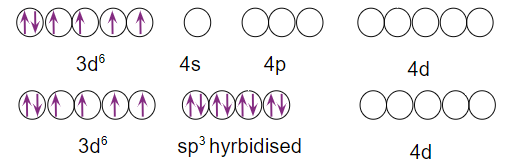
The nickel ion is in the +2 oxidation state and has the electronic configuration 3d8 in the paramagnetic tetrahedral complex .
Information:
n=2
The diagram depicts the hybridization scheme.

(2 unpaired electrons)

The paramagnetic tetrahedral complex has hybridisation (sp3).
Disadvantages of VBT
- Could not explain the identicality of bonds and angles in compounds like methane.
- Assumes the localization of electrons between the atoms but could not explain the polarity of bonds.
- In coordination compounds, while the VB theory explains the formation, structures, and magnetic behaviour of coordination compounds to a large extent, it has the following shortcomings:
(i) It is predicated on a number of assumptions.
(ii) Magnetic measurements are not provided for quantitative interpretation.
(iii) The colour of coordination compounds is not taken into account.
(iv) It does not offer a quantitative explanation of the thermodynamic or kinetic stabilities of coordination compounds.
(v) The square planar and tetrahedral structures of 4-coordinate complexes are not precisely predicted.
(vi) It is unable to distinguish between weak and strong ligands.
Related Video Link: Coordination Compounds Class 12 Chemistry (Ch-9) (L-1) | JEE Main Important Topics | JEE 2022 Exam
Practice Problems
- has a spin-only magnetic moment of 4.9 BM. Can you guess the geometry of the complex ion?
- Tetrahedral
- Trigonal Bipyramidal
- Octahedral
- Square planar
Answer: Because the coordination number of the Fe2+ ion in the complex is 4, the hybridisation will be either tetrahedral (sp3 hybridisation) or square planar (dsp2 hybridisation). However, because the complex ion has a magnetic moment of 4.9 BM, it should be tetrahedral in shape rather than square planar due to the presence of four unpaired electrons in the d orbitals.
The correct answer is (A).
- [Ni(CO)4] has a spin-only magnetic moment of 0 BM. Can you guess the geometry of the complex ion?
- Tetrahedral
- Trigonal Bipyramidal
- Octahedral
- Square planar
Answer: Because the coordination number of the Ni ion in the complex is 4, the hybridisation will be either tetrahedral (sp3 hybridisation) or square planar (dsp2 hybridisation). However, because the complex ion has a magnetic moment of 0 BM, it should be tetrahedral in shape rather than square planar due to the absence of vacant d orbitals.
The correct answer is (A).
- [Fe(CN)6]4- has a spin-only magnetic moment of 0 BM. Can you guess the geometry of the complex ion?
- Tetrahedral
- Trigonal Bipyramidal
- Inner orbital Octahedral
- Outer orbital Octahedral
Answer: Because the coordination number of the Fe2+ ion in the complex is 6, the hybridisation will be either inner orbital Octahedral (d2sp3 hybridisation) or outer orbital Octahedral (sp3d2 hybridisation). However, because the complex ion has a magnetic moment of
0 BM, it should be inner orbital Octahedral in shape rather than outer orbital Octahedral due to the absence of an unpaired electron in inner d orbitals
The correct answer is (C).
- Which of the following statement is correct about Valence bond theory?
- A Lewis base and a Lewis acid react to produce a coordinate covalent bond, which results in the development of a complex.
- With ligand orbitals that can provide electron pairs for bonding, these hybrid orbitals are permitted to overlap with them.
- The number of unpaired electrons, as indicated by the magnetic moment of the compounds, determines which d-orbitals are utilized.
- All of these
Solution: All statements are correct about valence bond theory. So the correct answer is an option (D).
Frequently Asked Question
- Why is VBT more successful than Werner's theory?
Answer: Werner's theory successfully describes the structures of many coordination compounds. It does not, however, explain the magnetic and spectral properties. Valence bond theory, primarily Linus Pauling's work, defined bonding as the overlap of atomic or hybrid orbitals of individual atoms.
- Why was VBT implemented?
Answer: The Valence Bond Theory was created to provide a quantum mechanical explanation for chemical interactions. The main focus of this theory is on how individual bonds are created from the atomic orbitals of the atoms that make up a molecule.
- What is the basis of the Valence bond theory?
Answer: The Lewis concept of the electron-pair bond serves as the basis for VB theory. In general, a bond between atoms A and B is formed in VB theory when two atomic orbitals, one from each atom, merge with one another and the electrons they contain pair up.
- What are some of the valence bond theory's most important contributions?
Answer: The need for maximum overlap, which results in the production of the strongest bonds possible, is a crucial component of valence bond theory. This idea explains how covalent connections develop in several compounds.


 Call Now
 Let's Chat
 Share
Share