-
Call Now
1800-102-2727


Enthalpy of Combustion - Definition, Standard Enthalpy of Combustion, Reference state of an element, Practice Problems and FAQs

What do you think which fuel is better for our daily use vehicles such as motorbikes and cars? Mostly we use two types of fuels for our cars, one is petrol and another one is diesel and you can’t mix up these fuels. Car engines are specially designed for a particular type of fuel, either it's a petrol car or a diesel car. Now, out of curiosity, what if we use diesel as fuel in a petrol car? Let’s discuss first what the engine does. Inside the engine, combustion of fuel with oxygen takes place which further converts heat energy (produced from the combustion reaction) into mechanical energy. Now, If a petrol car's engine is cranked with diesel in its tank, the spark plug and fuelling system will become clogged up by the stickier diesel, as will the fuel filter. As a result, the car will likely stall, and the engine will misfire and emit a lot of smoke. Both petrol and diesel engine works differently.
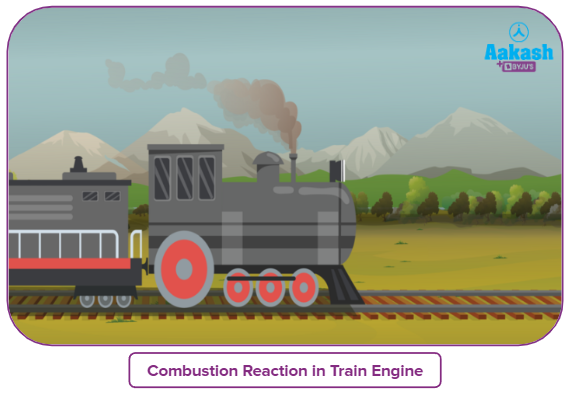
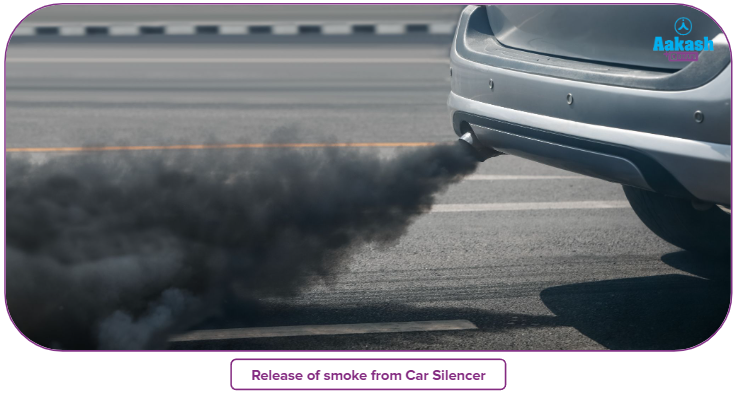
A diesel engine produces a lot of smoke as compared with a petrol engine. But as a fuel, per litre diesel has more calorific value if compared with petrol. Wait! what is this calorific value? So, it is the amount of energy produced when the specific amount of fuel is combusted in the presence of air. So, the diesel engine produces more power but more pollution as well. Depending on the calorific value, we actually use the fuel for our vehicles.
|
Fuel |
Calorific value (kJ/kg) |
|
Cow dung cake |
6,000 - 8,000 |
|
Coal |
25,000 - 33,000 |
|
Biogas |
35,000 - 40,000 |
|
LPG |
55,000 |
|
Hydrogen |
1,50,000 |
So, some substances produce more heat when combusted and some produce less amount of energy for the same amount of substance. To actually know which fuel is best for what applications, we need to know, how much energy this fuel can produce, which also can be said as enthalpy of combustion. So, let’s discuss in detail what the enthalpy of combustion is?
Table of contents
- What is Enthalpy of Combustion?
- Standard Enthalpy of Combustion
- Reference state of an element
- Enthalpy of Combustion and Enthalpy of Reaction
- Application of Standard Enthalpy of Combustion
- Practice Problems
- Frequently Asked Questions-FAQs
What is Enthalpy of Combustion?
The heat energy released when one mole of a substance burns entirely in excess of oxygen is known as the enthalpy of combustion. It is denoted by cH.
Standard Enthalpy of Combustion
The standard enthalpy of combustion is defined as the enthalpy change when one mole of a
substance undergoes combustion and all the reactants and products are in their standard states at the specified temperature. The standard enthalpy of combustion is denoted as
Burning of paper, coal, etc., are some examples of combustion.
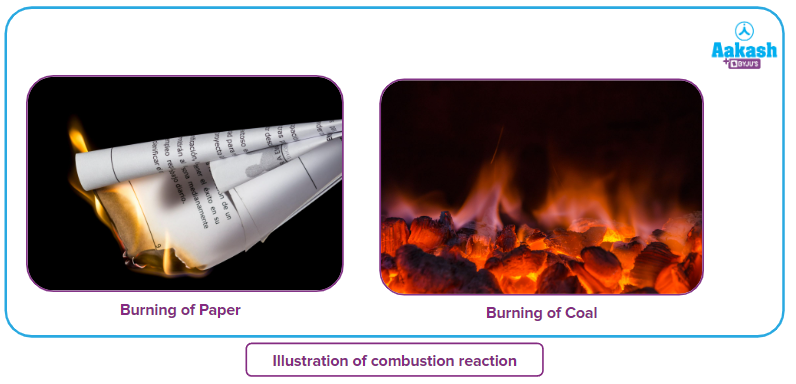
Some other examples of combustion reactions:
The reaction of combustion of glucose is given below.
C6H12O6(s) + 6O2(g) ⟶ 6CO2(g) + 6H2O(l), cHo= −2802 kJmol-1
Above reaction specifies the combustion of one mole of glucose as all the reagents are in their standard states. Combustion of one mole of glucose gives 6 moles each of carbon dioxide (CO2) and water (H2O) as products. is negative for the reaction, so it is exothermic in nature.
The reaction of combustion of graphite is also the reaction of formation of CO2 (g). Therefore, the enthalpy of formation is equal to the enthalpy of combustion in this reaction.
The given reaction is combustion reaction for hydrogen as well as a formation reaction of
Water. So, here also the enthalpy of formation is equal to the enthalpy of combustion in this reaction.
Generally, combustion reactions are always accompanied by the evolution of heat, therefore, the value of is negative.
Reference state of an element
Reference state is defined as the most stable state of aggregation of substances at 25oC and 1 bar pressure. For example, the reference state of both dihydrogen (H2) and dioxygen (O2) is gas. Similarly carbon and sulphur are Cgraphite and Srhombic solids, respectively.
All elements in their naturally available states are supposed to be in standard conditions. Examples are oxygen gas, solid carbon in the form of graphite, etc. For all elements in their reference state, i.e., their most stable state of aggregation, the standard enthalpy of formation
is zero.
Enthalpy of Combustion and Enthalpy of Reaction
Consider the formation of C2H6 by the reaction of C2H4 and H2.
Let us consider the heat of formation of C2H6 be -x kJmol-1 .
C2H4 (g) + H2 (g) C2H6 (g);
Let us consider the heat of combustion of C2H4 , H2 and C2H6 be -a kJmol-1 ,-b kJmol-1 ,-c kJmol-1 respectively.
The combustion of each of the species involved in the equation (1) is given as:
Combustion of 1 mol of ethene, C2H4 (g);
………….......(2)
Combustion of 1 mol of hydrogen, H2 (g);
…………................................(3)
Combustion of 1 mol of C2H6 (g);
……………..(4)
On reversing reaction (4), we obtain:
……………..(5)
On adding (2), (3), and (5), we obtain:
……which is same as equation (1).
So, here -a kJ mol-1 and -b kJ mol-1 are the heat of combustion of C2H4 and H2 (both are reactants ) while -c kJ mol-1 is the heat of combustion of C2H6 (which is a product).
To generalise this, the enthalpy of reaction for a particular reaction can be given as:
(n' and n are the number of moles of reactants and products respectively.)
Application of Standard Enthalpy of Combustion
By calculating the enthalpy of combustion we can find the calorific value which refers to the amount of heat released during the complete combustion of a unit mass of a substance. It talks about the quality of fuel. The higher the calorific value, the better will be the quality of fuel.
Example:
Suppose one mol of CH4 has the heat of combustion y J mol-1.
Molar mass of CH4 = (12 + 4) g mol-1 = 16 g mol-1
16 g of CH4 has the heat of combustion = y J mol-1
∴ 1 g of CH4 has the heat of combustion =
This is known as the calorific value.
Units of calorific value: Jg-1 or Cal g-1
Practice Problems
Q. Enthalpy of combustion is:
- Always Positive
- Always Negative
- Can be positive or negative
- None of the above
Answer: (B)
Solution: Enthalpy of combustion is the amount of heat released when one mole of a compound is combusted (completely) in excess of air (O2). So, if the heat is released, change in enthalpy would be -ve.
Q. Calculate the standard enthalpy of formation of carbon disulfide, given that the standard enthalpy of combustion of carbon (s), sulphur (s), and carbon disulfide (l) are 390, 290, and 1100 kJ mol-1 respectively.
Solution:
Given:
Applying this operation on the equations, eq (1) +2eq (2) - eq (3), we get;
So, standard enthalpy of formation of carbon disulfide (l) is 130 kJ mol-1.
Q. The heat of combustion of CH4, C2H4 and C2H6 is –890, –1411 and –1560 kJ mol-1, respectively. Which of the following has the lowest calorific fuel value in kJ g-1?
a. CH4
b. C2H4
c. C2H6
d. All of the above.
Answer: (B)
Solution:
Step 1: Calculating the calorific value of CH4
Molar mass of CH4 = (12 + 4) = 16 g mol-1
= -(-890) kJ mol-116 g mol-1
= 55.625 kJ g-1
Step 2: Calculating the calorific value of C2H4
Molar mass of C2H4 = ((12x2)+ (4x1)) = 28 g mol-1
Calorific value = -cHoMolar mass of the substance
= 50.39 kJ g-1
Step 3: Calculating the calorific value of C2H6
Molar mass of C2H6 = ((12x2) + (6x1)) = 30 g mol-1
= 52 kJg-1
So, C2H4 has the lowest calorific fuel value.
4. Calculate the enthalpy of formation of acetic acid using the given information.
- Combustion of Acetic acid
- Combustion of Grahite
- Combustion of Hydrogen
Solution:
The formation reaction of acetic acid is:
Given:
Applying this operation on the equations, 2eq (3) +2eq (2) - eq (1), we get;
Frequently Asked Questions-FAQs
Q1. What is the difference between standard reaction enthalpy and standard enthalpy of combustion?
Standard enthalpy of combustion is defined as the enthalpy change when one mole of a substance is completely burnt in the presence of oxygen with all the reactants and products in their standard state under standard conditions (298K and 1 bar pressure) while the standard enthalpy of reaction ( ) is the enthalpy change that occurs in a system when the matter is transformed by a given chemical reaction when all reactants and products are in their standard states under standard conditions (298K and 1 bar pressure).
Q2. Is it possible for the enthalpy of combustion to be positive?
Answer: The answer to this question is no. Enthalpy of combustion is the heat energy released when one mole of a substance burns entirely in oxygen and the combustion reactions are always accompanied by the evolution of heat, therefore, the value of is always negative.
Q3. Can you tell us some real-life examples of enthalpy in action?
Enthalpy in operation can be seen in refrigerator compressors and chemical hand warmers. The vaporisation of refrigerants in the compressor and the reaction to iron oxidation in a hand warmer both induce a change in heat content under constant pressure which is enthalpy change.
Q4. What is the enthalpy of combustion used for?
In combustion reactions, some substances will release more energy than others. Enthalpies of combustion can be used to compare which fuels or substances release the most energy when they are burned. So, with this information, a particular type of substance can be used in particular applications.


 Call Now
 Let's Chat
 Share
Share