-
Call Now
1800-102-2727



Conservation of angular momentum, definition and mathematical expression, practice problems, FAQs
You might have gone to the circus and saw the acrobats performing feats. If you’d observe carefully, while performing feats involving spin they bring their arms and legs closer to the body and suddenly they start spinning faster. Ever wondered why it happens? You would have known if you knew about angular momentum conservation. It also answers why earth keeps spinning.
Table of contents
- Conservation of angular momentum
- Conservation of Angular Momentum about an Axis
- Steps for solving problems
- Practice problems
- FAQs
Conservation of angular momentum
The angular momentum of the system is conserved when the net external torque acting
on the system is zero, i.e.,


Conservation of Angular Momentum about an Axis
If the net torque acting about an axis is zero, then the angular momentum about the same axis is constant.


Steps for solving problems
1. The axis about which the net torque is zero should be chosen.
2. If the net torque about that axis is zero, then the momentum is conserved about that axis.
Point to Remember
- Law of conservation for angular momentum is conditional and depends on the axis.
- If two bodies have the same angular momentum, then the body having less moment of inertia will rotate faster.


If 
This is the reason why ballet dancers fold up their arms while spinning.
- If the external torque acting on the system adds up to zero in a particular direction, then we can say that the angular momentum of the system is constant in that direction.
Practice problems
Q. A boy of mass M stands at the edge of a platform of radius R that can be freely rotated about its axis. The platform is having moment of inertia I. The system is at rest when a friend throws a ball of mass m and the boy catches it. If the speed of the ball is v and is horizontally along the tangent to the edge of the platform when it was caught by the boy, find the angular speed of the platform after the event.

A. Given,
Let I = Moment of Inertia of the platform
Radius of the platform = R
Speed of the ball = v
Mass of the ball = m
Mass of the boy = M
Two different situations.
1. When the boy was initially at rest
2. After he catches the ball, both the boy and the platform come in motion.
As soon as the boy catches the ball, the platform along with the boy starts rotating.

Let  be the angular velocity of the platform.

The scenario can be well explained in the following diagram as viewed from the top of
the platform.
By using the principle of conservation of angular momentum for the system (Platform + Boy + Ball) before and after the time when the boy catches the ball, we get the following:
I.e. for “Platform+Boy+Ball” angular momentum is conserved
 (About the axis)


Or 
Q. Suppose the platform and the boy with a ball of mass  in his hand standing on the rim are at rest. The moment of inertia of the platform is
  and the mass of the boy is
  . The boy throws the ball horizontally with a speed
  in a direction which is tangential to the rim as seen by his friend. Find the angular velocity of the platform when it begins rotating.

Solution
Given,
Moment of inertia of the platform 
Radius of the platform 
Speed of the ball 
Mass of the ball 
Mass of the boy 

Initially, the system of the boy, ball, and platform is at rest. However, when the boy throws the ball with a velocity which is tangential to the rim, the platform along with the boy acquires some angular velocity in the opposite direction.
Since all three, i.e., ball, boy, and platform, are at rest, the initial angular momentum of the system is zero. By using the principle of conservation of angular momentum of the system, we get the following:

I.e.  [Negative sign suggests the opposite direction angular momentum]
So, we get

Q. Consider a thin circular ring rotating at a constant angular velocity  about its axis and having mass M and radius r. Four objects, each of mass
  , are kept gently to the opposite ends of the two perpendicular diameters of the ring. What will be the angular velocity of the ring?

Solution
As the objects are placed gently on the ring, it will not affect the net torque of the system.


Q. A uniform rod hinged at H having mass m and length  rotates freely on a smooth horizontal plane about a vertical axis. A point mass having the same mass , coming perpendicular to the rod strikes the rod inelastically at its free end with an initial speed
  . At an instant just post the collision, what is the angular velocity of the rod?

A.

Considering the principle of conservation of angular momentum for the system of point mass and the rod about the hinge point H,

Initial angular momentum of point mass and rod = Final angular momentum of rod


Question
A homogeneous rod AB  longhaving mass M is pivoted at centre O can rotate freely in the vertical plane but is initially in the horizontal position. An insect S of mass M falls vertically with a speed v on point C, which is midway between the points O and B. The insect moves towards end B immediately after falling such that the rod rotates with a constant angular velocity
  . Determine the angular speed in terms of and .
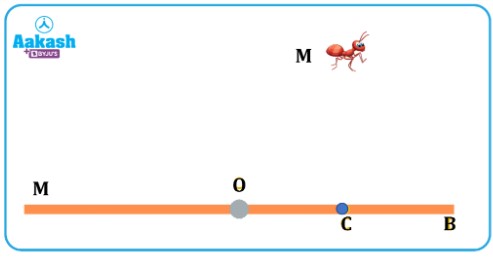
(Recreated the image)
A.
Given,
Mass of the rod = M
Length, l = 1.8 m
Mass of the insect = M
Velocity with which the insect fall on point C = v
Let the rod rotate with a constant angular velocity .
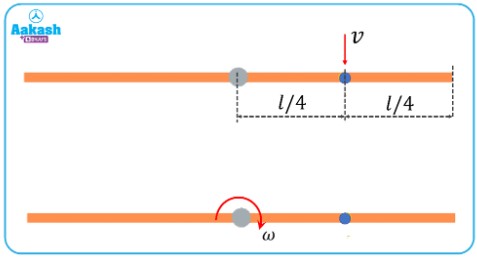
The angular momentum of the insect and rod will get conserved about the hinge (pivot). So, using the principle of conservation of angular momentum, we can write it as follows:
(About the hinge)


FAQs
Q. Does the angular velocity of revolution of the planet around the sun in elliptical orbit remain constant?
A. No, the angular velocity changes since the moment of inertia changes due to the change in the distance between the sun and the planet.
Q. Why does a raw egg spin slower as compared to a hard boiled egg?
A. The moment of inertia of the raw egg is greater than that of hard boiled egg since the liquid inside the egg moves away from the centre and thus the radius of gyration increases. As the angular momentum remains conserved for both, therefore raw egg spins slower as compared to hard boiled egg.
Q. Explain if the angular momentum is completely analogous to linear momentum?
A. Yes, both angular momentum and linear momentum are completely analogous. Although they have different units and are not directly inter-convertible like forms of energy are.
Q. A particle undergoes uniform circular motion. The angular momentum of the particle remains conserved, about which point on the plane of the circle?
a. centre of the circle.
b. on the circumference of the circle.
c. inside the circle.
d. outside the circle.
A. In uniform circular motion, the force on the particle passes through centre of the circle so its torque about this point is zero and angular momentum remains conserved

 Call Now
 Let's Chat
 Share
Share